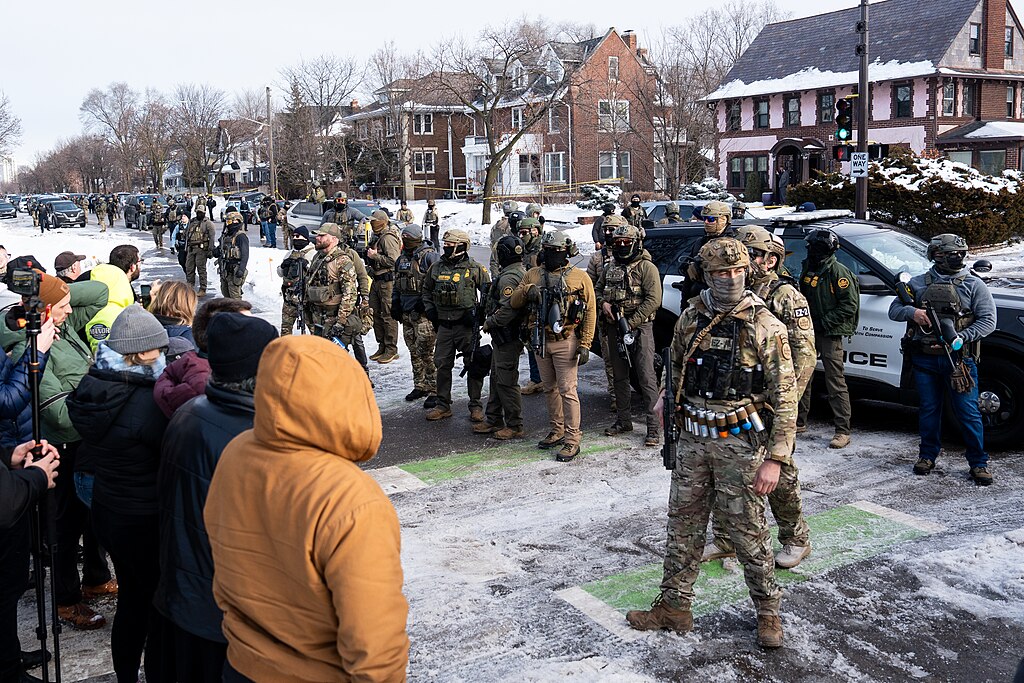
Portland Avenue and 34th Street in South Minneapolis where City of Minneapolis officials have confirmed an ICE agent shot an observer. A neighbor who saw what happened told local MPR news: “She was trying to turn around, and the ICE agent was in front of her car, and he pulled out a gun and put it right in — like, his midriff was on her bumper — and he reached across the hood of the car and shot her in the face like three, four times.” (Photo: Chad Davis, Wikimedia Commons.
By Ingrid C. A. Rasmussen
On June 3, 2025—just hours after I returned from a lovely vacation—I received a text message from my colleague, Pastor David Larson-Martínez, saying that armored vehicles and federal agents were stationed nearby at the corner of Lake Street and Bloomington Avenue—one of Minneapolis’ most gorgeous, immigrant-rich intersections.
When I arrived at the scene, I was stunned by the overwhelming militarized federal presence. ICE, FBI, DHS, HSI and ATF were all present. Masked agents with assault rifles slung across their chests offered no information to those gathered on the street, treating concerned neighbors as potential threats rather than human beings deserving of basic dignity. Neighbors stood shoulder-to-shoulder, steadfast in their demand for answers.
In the days that followed, officials suggested that the raid was, in fact, not an immigration raid. They reported that a significant amount of illegal drugs were found at an affiliated site. They said that protesters gathered should have allowed authorities to do their work unimpeded—that it was unarmed civilians that made the situation unsafe. The message was clear: The community should have simply trusted the movements of federal authorities leading the enforcement operation and the county and city officers who were called in when the situation grew tense.
That call for blanket compliance does not acknowledge the moment in which we find ourselves living. Regardless of the circumstances of the raid, what we saw deployed on Lake Street—directly across the street from a daycare and a grocery store—was over-scaled state violence against a Latine community that has already endured more than its share of trauma. State intimidation often masquerades as public safety measures. We are told that these military-style operations are necessary to protect civilians.
But we know better. That scene was not the Lake Street I know and love. It was a full-blown military operation—armored trucks, machine guns, chemical irritants and chaos unleashed in a neighborhood that deserves dignity—not domination. We can tell ourselves that men in masks, tactical gear and battlefield weapons storming local businesses in unmarked vehicles is normal. Or we can refuse that narrative. We can insist that our community deserves better. That our collective dream of safety and liberation is not only possible, but essential and demands more than what we see unfolding in communities across the country.
I am a farm kid who now serves in the beautiful heart of a city. I know what real safety looks like. It looks like small businesses that can thrive without fear of sudden raids. It looks like communities where people can call for help without worrying about deportation. It looks like school kids who can trust that their parents will be there to pick them up at the end of the day. It looks like neighbors—across lines of race, gender, class, documentation status or ability—who know each other’s names.
The late theologian Howard Thurman said that “fellowship”—this connection across demographic divides—isn’t just nice to have; instead, he asserted that it is the antidote to hatred. In his book Jesus and the Disinherited, he writes that “hatred often begins in a situation in which there is contact without fellowship, contact that is devoid of any of the primary overtures of warmth and fellow-feeling and genuineness.”[1] Hatred, a root of injustice, grows when people are reduced to transactions.
Real safety is not created by masked men carrying machine guns. It is not built through the deployment of military vehicles on city streets or township roads. It is not achieved by creating a climate of suspicion. These tactics may create the illusion of security for some, but they make everyone less safe by fraying the social fabric that holds our communities together. To be clear, I am not opposed to community safety; I am simply opposed to the idea that, with alarming regularity, my neighbors and I are forced to come face-to-face with weapons of war and fear tactics dressed up as policy choices.
There is a better way—and it will necessitate all of us—particularly those with unearned privilege who could choose to self-protect—taking generous risks. Sharon Welch, a feminist theologian who writes about the ethic of risk, reminds us that those who enter justice struggles do so from a place of incomplete understanding.[2] We cannot predict outcomes, but we are still called to act. Responsible action, as Welch frames it, means committing to care and act even without any promise of success, and resisting the temptation to despair when problems appear overwhelming. In this way, an ethic of risk grounds us in the courage to move forward without guarantees.
She also listened deeply to communities long oppressed, especially women of color. From their witness she learned that courage is sustained by at least three essential elements: a redefinition of responsible action—what once seemed reckless might in fact be the faithful thing; grounding in community—a community far larger than any single entity; and strategic risk-taking—daring to begin the work even before we know how it will all end. Resistance to systemic violence is never solitary but always communal: a shared journey that requires risk, humility and the conviction that transformation is possible even when we cannot yet see its fullness.
Along Lake Street, these truths take flesh each day: neighbors standing shoulder to shoulder in protest, congregations opening their doors in times of crisis, and community organizations weaving fragile threads of hope into a fabric strong enough to resist despair. At its best, the church I serve embodies this resilience—a community of resistance and resurrection, sustained by God’s love and sent again and again into the world for the sake of justice, courage and liberation.
On June 3, my clergy friend Pastor Hierald Osorto reminded me that “even in the face of fear, there is power in community that flows from the very heart of God.” I hear that pulse every day on Lake Street. And I trust that—even in our current suffering—God is leading us toward justice, not through domination or fear, but through the deep, courageous love we embody when we show up for one another. This is the heartbeat of the Christian life: to stay rooted in community, to lift up the stories born from our shared experiences, and to trust that God is already at work—moving us toward courage, connection and collective joy. This is what becomes possible when the church shows up—in love and imagination—to risk for the world God so deeply loves.
— Rev. Ingrid C. A. Rasmussen, ordained in 2013, serves as lead Pastor at Holy Trinity Lutheran Church in Minneapolis. A public theologian and community leader, she is deeply committed to justice and active engagement in the public square. Her writing has appeared in The Christian Century, Faith & Leadership, Journal of Lutheran Ethics, and she is a contributing author to Parenting for a Better World (Chalice Press, 2021).
__________________________________
[1] Howard Thurman, Jesus and the Disinherited (Boston: Beacon, 1976), 75.
[2] See Sharon D. Welch, A Feminist Ethic of Risk, rev. ed. (Minneapolis: Fortress, 2000).