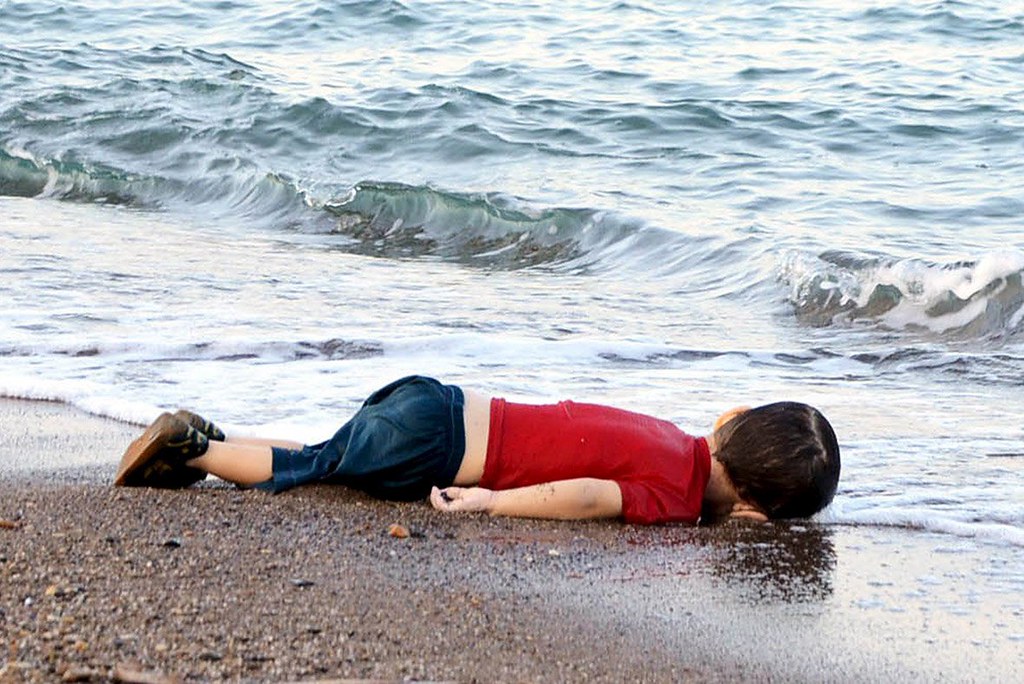
Aylan Kurdi was a three-year-old Syrian boy of Kurdish ethnic background whose image made global headlines after he drowned in the Mediterranean Sea, as part of the Syrian refugee crisis. Photographs of his body were taken by Turkish journalist Nilüfer Demir and quickly spread around the world, prompting international responses. (Photo: Public Domain)
By Rev. Manuel Retamoza
Content warning: descriptions of the tragic death of children and other violence against immigrant people
In September 2015, front-page images of a young toddler lying facedown on a beach captured the world’s attention. We witnessed global outcries and deep sadness as the story emerged about Alan Kurdi, a Syrian toddler who drowned while trying to escape violence in his home country. He and his family fell from an overcrowded boat while heading to Greece.[1]
In the same month, local immigration justice advocates in San Diego learned about a tragic incident involving a young mother and her three small children. After crossing the international border, they were abandoned by a “coyote” in the sweltering heat of the California desert of Imperial County. Tragically, the mother died in the hostile desert conditions, surrounded by her three children who survived the ordeal. No news outlets covered her death, and her name and identity remain unknown to the public. According to trusted sources, one of her children was named Jesús.
As I write this, it has been almost exactly 10 years since both of these horrific events occurred. However, public discourse on immigration has only become more hostile and divisive. Immigrants are often dehumanized and treated as political pawns, resulting in immeasurable suffering and loss of life. As the number of immigrants has increased, the response from news outlets, our society, and the Christian Church in the United States has only contributed to the harm caused.
Amid this tension, our Christian call is to proclaim Christ crucified and risen, and a faith that is rooted in the love of God and our neighbors. Our Christian teachings on love, justice and mercy urge us to respond with humanity and compassion to the immigration crisis in the United States and worldwide. The scriptures, which are often used by leaders to divide our society, clearly instruct us on how to treat, honor and advocate for immigrants and refugees.
Biblical mandates form the foundation of the broader Christian faith and guide us as people of faith and children of God to serve our neighbors. In Matthew 25:31-46, a passage often titled “The Judgment of Nations,” Jesus instructs us to clothe the naked, feed the hungry, give water to the thirsty, and welcome the stranger. It is a response that is both simple and profound to God’s call to us as Christians, with warnings of what will come if we ignore these mandates.
In the book of Leviticus and various other passages in the Old Testament, we find important teachings that offer essential guidance that call for compassion: “When an alien resides with you in your land, you shall not oppress the alien. The alien who resides with you shall be to you as the native-born among you; you shall love the alien as yourself, for you were aliens in the land of Egypt: I am the Lord your God” (Leviticus 19:33-34, NRSVue). This message is not new; it is an ancient call to all who claim the Bible as the word of God and the cradle of our faith. So, it is clear the concept of “neighbor” in the biblical context carries significant implications for immigration policy.
As people of faith, how can we balance the teachings of scripture with the reality that many of our immigrant neighbors already in the U.S. are facing discrimination and being targeted by masked individuals armed with weapons, all under the pretext of “public safety?”
Recently, my co-pastor at St. Andrew’s Lutheran Church and I were asked to accompany a friend from our congregation to immigration court after he received a notice to appear. We invited another pastoral colleague and our synod bishop to join us and wear our clerical collars as a visual symbol. At every step of our journey into and out of the courthouse, we were thanked for being present and asked to come back. We were told by lawyers and volunteer court observers that when faith leaders are present at the courthouse, there seem to be fewer people detained by ICE agents in the halls outside the immigration court hearings. In order to enter the courtroom, we had to walk through what felt like a sea of masked and weaponized ICE agents in cargo pants. Two of the pastors in our group started to accompany people out of the courtroom and to the elevators, standing by them as they were stopped and questioned, tension lingering in the air.
While I anticipated that we would be confronted with the fear and intimidation techniques being employed by ICE agents against those entering and exiting the immigration court, what I didn’t anticipate was how triggering their presence would be for me personally. As a first-generation Mexican American who has crossed the border regularly for my entire life, I have long been aware that the foundation of our immigration system assumes that immigrants are guilty until proven innocent. Instead of acknowledging the humanity of immigrants and asylum seekers, the rhetoric is to call people “illegals,” as if legality equates to morality. Instead of receiving the stories of people, most of whom endure physical and emotional trauma before they even arrive at the border, with empathy and compassion, we “other” them and treat them like criminals. These practices are not new. My own family carries the stories of the difficulties they endured in order to establish a new life here in the United States.
My own awareness of this injustice has long drawn me to spend time at the border, to provide immersion tours and classes discussing the complex dynamics of immigration and faith, and specifically to return again and again to an area at the border wall between San Diego and Tijuana called Friendship Park. Inaugurated in 1971 by Pat Nixon, Friendship Park was meant to be a symbol of friendship between the U.S. and our neighbor, Mexico. Mrs. Nixon was heard to say that day at the park, “I hope there won’t be a fence too long here.” She then asked that the wire be cut so she could walk into Mexico and greet people. Although not mentioned in any articles, she may have also wanted to visit a taco stand to get some TJ Playas tacos.
Friendship Park is also the home of Border Church, an international worshiping community, established informally by Rev. John Fanestil in the early 2000s. Fanestil, a United Methodist pastor, began this ministry by bringing communion and sharing it through the border fence with people on the other side, a symbol of the transcendence of God’s love and grace. Soon, that simple act of occasionally sharing communion through the wall on Sunday afternoons developed into a consistent practice for Fanestil and others, eventually leading to a weekly communion service on both sides of the wall, known as Border Church.
Border Church is now an established worshiping community separated by an international boundary. It is currently divided by two 30-foot walls with a detainment space in between, which I call “No Man’s Land,” and the interior walls are covered in razor wire. In the beginning at Friendship Park, people, including myself, were able to touch and greet one another through a chain-link fence. We truly worshiped together as one congregation, hearing the word preached, singing songs, praying together, sharing communion across the border, and creating a full circle, divided only by a fence for blessings and to break bread together. After years of communing with Border Church when I could, and then partnering with Border Church leadership to assist and support their work along the border, I was called to take on the mantle of Border Church pastor in June of 2025.
Border Church, rooted in our Christian identity, has passionately championed immigrant rights and supported deported individuals for many years. Since the wall construction in 2009, the mission has become even more focused, as we welcomed an increasing number of deported individuals and asylum seekers among our Sunday afternoon parishioners. In the spirit of fostering community, we draw upon the insights found in Paul’s epistle to the church in Thessalonica, specifically Chapter 5, where he advocates for the provision of unwavering support to one another:
But we appeal to you, brothers and sisters, to respect those who labour among you, and have charge of you in the Lord and admonish you; esteem them very highly in love because of their work. Be at peace among yourselves. And we urge you, beloved, to admonish the idlers, encourage the faint-hearted, help the weak, be patient with all of them. See that none of you repays evil for evil, but always seek to do good to one another and to all. Rejoice always, pray without ceasing, give thanks in all circumstances; for this is the will of God in Christ Jesus for you. Do not quench the Spirit. Do not despise the words of prophets, but test everything; hold fast to what is good; abstain from every form of evil (1 Thess 5:12-21, NRSVue).
Through collaborative efforts, we are able to lift up individuals and cultivate a nurturing environment for all those seeking solace and hope.
Over the years, Border Church on the U.S. side has been forced to move its place of worship because of the ongoing construction work on the wall and the flooding of the Tijuana River Valley (U.S. side). Until just a few weeks ago, we most often worshiped outside what Customs and Border Patrol named Whiskey 8 (West 8 gate of the secondary wall), about three miles east of Playas, the Tijuana site of Border Church. For the last few years, Border Church has worshiped on the newly-taken federal land, with only the secondary wall being the border itself. This congregation is migratory, as it continues to serve migrants in both the United States and Mexico.
On the U.S. side at Whiskey 8, from 2023-24, those gathered shared in the Eucharistic meal and provided food and necessities to those being detained between the walls under the ever-present eyes of the Customs and Border Police. The church and other non-profits offered items for those detained, including foil blankets, basic foods (ramen, bars, fruit, water, coffee and tea). During this time, many of the migrants asked for prayers for safety and blessings. We heard many languages spoken among families from all over the globe, as well as a few indigenous languages of Mexico and Central America. On the Baja side at La Playas, they have continued to worship in the same space throughout the construction and added a “love feast,” a lunch provided by one of the shelters in Playas de Tijuana, Casa La Luz.
The Border Church is dedicated to a work and ministry that echoes the early Christian church in the centuries following the resurrection of Jesus Christ. Our mission is to respond to the call to resist oppressive systems, fear of the other, and to promote unity instead of division through sacramental worship. It was not fear that motivated the early followers of The Way. Rather, they were driven by a spirit of service and a willingness to share what they had with others.
Today, churches across the United States, along with the larger church community and various Lutheran advocacy organizations, including Global Refuge, ELCA AMMPARO Migrant Ministry, and Lutheran World Relief, stand up for the rights of the poor, marginalized and migrants. We can all advocate for policy changes that combat the divisions created by oppressive systems that separate God’s people based on skin color and ethnicity. We strive to confront racism and exploitation wherever they exist.
How would our world and country change if the church and its members began to see everyone as friends, neighbors and children of God? By avoiding terms like “illegal” or “alien” and instead recognizing each other as siblings in Christ, we could restore the humanity of those we label and reclaim the humanity of those who use such terms. We could name the collective grief we feel when sin and brokenness result in the unnecessary suffering and deaths of people who have been forced to leave their homelands.
— Pastor Manuel Retamoza (MDiv. Luther Seminary ’04) is co-pastor at St. Andrew’s Lutheran Church and astor at the Border Church in San Diego, California. Manuel holds leadership roles in the ELCA Youth Ministry Network, the American Indian and Alaskan Native Association, and the ELCA Doctrine of Discovery task force, and is a Wisdom Keeper for Indigenous Leadership Education (PLTS).
_________________________________
[1] Helena Smith, “Shocking Images of Drowned Syrian Boy Show Tragic Plight of Refugees, The Guardian, September 2, 2015, https://www.theguardian.com/world/2015/sep/02/shocking-image-of-drowned-syrian-boy-shows-tragic-plight-of-refugees.