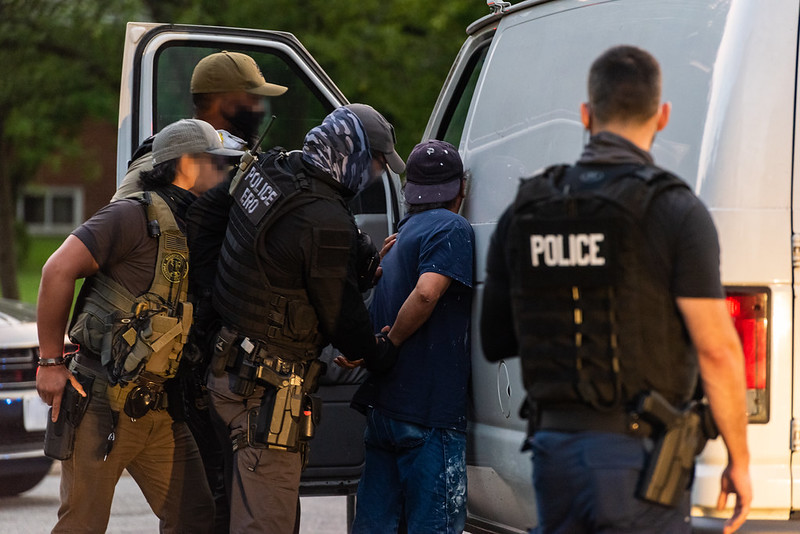
(Photo: Public Domain)
By Isaac Villages
At a law enforcement conference in 2008, James Pendergraph, the executive director of U.S. Immigration and Customs Enforcement’s Office of State and Local Coordination, presented the work of his agency to representatives of police and sheriff departments throughout the country. “If you don’t have enough evidence to charge someone criminally but you think he’s illegal,” he said, “we can make him disappear.”[1]
Disappearances have been part of the plan for a long while—a plan awaiting implementation on a mass scale, a plan fit for a president with authoritarian aspirations. This past summer, during the first week of June, marauding ICE agents arrested over 700 people in Los Angeles, California. Family members scrambled to figure out the whereabouts of loved ones taken from them.[2] Some are still searching.
Before Pendergraph, as a federal official, boasted about ICE’s expertise in disappearing people in 2008, he was the sheriff of North Carolina’s Mecklenburg County, a tenure that stretched across the turn of the millennium, from 1994 to 2007. As sheriff, he spearheaded the nation-wide movement among police chiefs and sheriffs to link their city and county offices to the Department of Homeland Security, to enable local officers to coordinate their policing with ICE. Sheriff Pendergraph championed the 287(g) program, a provision in federal law (Section 287(g) of the Immigration and Nationality Act of 1996) which allows officers “to detect, detain, and deport” undocumented residents.[3] The law enables the DHS to deputize local law enforcement personnel to act as immigration enforcement police. (Immigration has been a federal matter, not the concern of state law.)
Sheriff Pendergraph jumped at the opportunity to target immigrants in his jurisdiction, which included Charlotte, the most populous city in North Carolina. “These people are coming to our country without documents, and they won’t even assimilate,” he told a Charlotte Observer reporter in 2006.[4] He considered people from Latin America who live in the United States without legal permission to be threats to the social order because they refuse acculturation. Undocumented members of our community, according to Pendergraph, damage social cohesion. They shred our cultural fabric. These people, he called them, are unwilling to assimilate.
In the early 2000s, the DHS found North Carolina to be a hospitable state for ramping up their ICE partnerships with city and county law enforcement offices. In a 2010 report, researchers at the University of North Carolina at Chapel Hill observed that, of all the states in the country, North Carolina had the most county and municipal jurisdictions participate in the federal 287(g) ICE ACCESS program.[5] The study further noted:
“In addition to the 287(g) Program, the Department of Homeland Security is piloting a similar initiative in the state called Secure Communities and plans to implement this program nationwide over the next four years. As a result, North Carolina is an important laboratory for examining the implementation of local immigration governance.”[6]
North Carolina has been an important site for ICE to experiment with its ability to insinuate itself into local enforcement jurisdictions—to stretch the reach of federal power as far as our legal and political arrangements will allow. In her Behind Crimmigration: ICE, Law Enforcement, and Resistance in America, Felicia Arriaga offers a comprehensive analysis of ICE’s infiltration throughout localities in North Carolina. “Between 2006 and 2008,” she explains, “places like North Carolina became the testing ground for various immigration enforcement practices meant to target the increase of mostly Latinx immigrants.”[7] Arriaga also recounts the efforts of communities to organize their resistance to ICE—grassroots struggles to unlink local cooperation with federal “crimmigration” policies.[8]
These communal efforts of political resistance, over a decade, achieved electoral results. In 2018 several sheriff candidates ran on a commitment to cancel 287(g) and Secure Communities partnerships with ICE—and they won, including in some of the largest counties in the state.[9] Gary McFadden’s victory in Mecklenburg County attested to the strength of pro-immigrant political organizing to shift the common sense of the voting public. This was a profound change in popular sentiment when considered in the light of Pendergraph’s long incumbency: he won four consecutive sheriff elections before his appointment to a federal position with DHS.[10] As soon as McFadden took over the sheriff’s office in December of 2018, he rescinded the 287(g) agreement that Pendergraph had put in place years before, which began ICE’s intrusion into the county’s law enforcement processes. On Sheriff McFadden’s first day on the job, he joined immigrant justice organizers at a Latino bakery where the owner, a Colombian immigrant, had made a sheet cake with a crossed-out “287(g)” written with frosting in the middle. McFadden signed the termination documents for the cooperation agreement then picked up a kitchen knife and cut across the cake, slicing through the 287(g) at the center.[11] There was a new sheriff in town, and his politics of law enforcement did not involve the targeting of undocumented members of the community.
During the first Trump administration, organized resistance to the federal policing of residents’ documentation statuses improved the social conditions for immigrants in North Carolina. And, our state discovered, a better life for immigrants has meant a better life for a large cross-section of the population, a liveliness that enriches all of society: the cultural traditions of food and music makers, the reinvigoration of religious life that comes with newcomers to a community, the gift of friendship offered with every new arrival to our neighborhoods, not to mention the economic growth resulting from immigrant labor. According to the non-partisan NC Budget & Tax Center and Immigration Research Initiative, in 2022 undocumented workers paid $692 million in state and local taxes. The report also notes that North Carolina industries related to food (more than half of crop workers and 14% of restaurant cooks are immigrants, many undocumented) and housing (13% of construction workers are undocumented) would collapse without immigrants, a majority of whom are undocumented.[12]
We all lose when neighbors, when co-workers, when friends, when members of our chosen or biological family have to live under the constant threat of arrest: the unrelenting fear of being snatched from loved ones, torn from a household. Life under the conditions of torment is a diminished existence, which weakens our interrelated communities, the wholeness of our shared lives, the dependencies that draw us into processes of mutuality.[13] What wounds one part of our community makes all of us wince. Distress ripples through the relationships that sustain our lives. The pain of deportation, the trauma of disappearances, screams through the social body.
Despite the realities of our connectedness—including the goodness of life in communion with others, as well as the economic health of our society—the Republican-led North Carolina legislature is currently facilitating President Trump’s agenda by means of a new law that contravenes local law enforcement priorities.[14] In order to push the federal administration’s anti-immigrant strategies, the GOP majority crafted a piece of legislation designed to undermine county and city policies that have restricted DHS involvement in their communities—like Sheriff McFadden’s refusal to cooperate with ICE. To pass their law, the state GOP representatives needed a member of the Democratic caucus to join their side, giving them the three-fifths supermajority required to override the governor’s veto. Representative Carla Cunningham, whose district includes Mecklenburg County, broke with her party to give Republicans the vote they needed for the bill. City, county, and state law enforcement agencies are now forced to cooperate with ICE, despite the will of residents to exclude immigration concerns from the purview of their police departments.
Recognizing that her vote was an affront to her Democratic colleagues, Rep. Cunningham asked to address the NC House from the floor, to offer an explanation. “I am ADOS, American Descendents of Slaves. I am a Black American, and I am an American,” Cunningham introduced herself to the legislative body. “As a people, we need to recognize that it’s not just the numbers that matter but also where the immigrants come from and the culture they bring with them.” Because, she continued, “all cultures are not equal.” People from other cultures (lesser cultures?) “must assimilate,” which the current type of immigrant refuses to do, Cunningham claimed, noting that she considers the maintenance of distinct languages to be destructive for social cohesion. “Do you think I can go to another country,” she continued, “and use the language I choose and then tell that country that you must speak my language? That is not going to happen.” Her focus on a national language as fundamental for her sense of peoplehood follows the lead of President Trump’s executive order in March: “It is therefore long past time that English is declared as the official language of the United States,” he announced. “A nationally designated language is at the core of a unified and cohesive society.”[15]
In Rep. Cunningham’s defense of her vote, she repeated nationalist right-wing talking points regarding demographic change and cultural decline. This was her “unapologetic truth,” which she offered as a call to “wake up,” for citizens to recognize global migration patterns—regardless of lawful or unlawful migration—as exploitative and abusive of U.S. peoplehood. “It’s time to turn the conveyer belt off,” because the current flow of migration is “destabilizing our communities,” she argued. “A large number of people entering a country can change it forever.” Her claim to belonging was the forced labor of her enslaved forebearers whose sweat is in the soil of this country. “It was my ancestors who came over as slaves, built this country with the strain on their backs, the sweat pouring from their bodies in the rice fields, the cotton fields and tobacco farms, for this country.” The coerced investment of her people into the productive power of the United States has issued her the rights and privileges of ownership which, she believes, authorizes her to exclude others from the cultural and political processes of making and re-making our society. “Today, if you ask me to line up behind another group of people to raise awareness about their plight, I unapologetically say no.”[16]
Rep. Cunningham’s demand for the cultural assimilation of immigrants—“they must assimilate”—echoed Sheriff Pendergraph’s statement from nearly a decade ago: “These people…won’t even assimilate.” Their claim about immigrants as unassimilable people is part of what Leo Chavez has identified as “The Latino Threat Narrative,” a discursive practice that imagines Central and South Americans in the United States as cultural and political invaders, dangerous to social life. In The Latino Threat: How Alarmist Rhetoric Misrepresents Immigrants, Citizens, and the Nation, Chavez tracks the development of this narrative from the late 20th century into the 21st, as expressed by media pundits, public intellectuals, and political leaders—a narrative which Chavez summarizes as follows:
The Latino Threat Narrative characterizes Latinos as unable or unwilling to integrate into the social and cultural life of the United States. Allegedly, they are prone to criminality, they do not learn English, and they seal themselves off from the larger society, reproducing cultural beliefs and behaviors antithetical to a modern life… Latinos are represented as an unchanging people, standing outside the currents of history, merely waiting for the opportunity to revolt and to reconquer land that was once theirs. They live to destroy social institutions such as medical care and education. They dilute the privileges and rights of citizenship for legitimate members of society.[17]
Cultural difference poses an existential threat, according to this fantasy. Groups of people in the United State who communicate in Spanish instead of English signal, according to this myth, the disintegration of civic life. “Latinos are represented as societal threats, thus causing them to be cast as illegitimate members of the community and undermining their claims for social and cultural citizenship,” Chavez lays bare the ideology expressed in the anti-immigrant politics of leaders like Pendergraph and Cunningham.[18]
The DHS is using this political vision in their advertising campaign to convince people to work for ICE. To drum up interest—and to stoke the fervor among nationalists—the DHS media account on X posted a series of images that characterize immigrants as threats to the cultural heritage of the United States. The post on June 11, 2025, was a cartoon of Uncle Sam, outfitted in his patriotic stars and stripes trousers, coattails, and top hat—a figure popularized for military recruitment during the early 20th-century World Wars now repurposed for a paramilitary agency. In the post Uncle Sam is nailing up an enlistment poster: “Help Your Country… and Yourself…” And below the poster, there is this injunction in all caps: “REPORT ALL FOREIGN INVADERS.”[19] In July, the DHS account posted a picture of a painting of a young couple gazing at an infant cradled in the mother’s arms, the three of them in a covered wagon—settlers who appear to be of white European descent, part of a caravan of pioneers headed West. The text above the painting reads, “Remember your Homeland’s Heritage.”[20] In August the post was straightforward: “Serve your country! Defend your culture! No undergraduate degree required!” with a link to Join.ICE.Gov. at the bottom.[21] These posts are a nostalgic appeal for the predominance of Euro-nationalist culture, which requires the displacement of other-than-white immigrants—that is, for some among us to be disappeared. Thus, the ideological need to enlist citizens into ICE’s paramilitary force, for conducting military operations in our neighborhoods: at grocery and construction supply stores, in our judicial courts and city parks, outside schools and churches and workplaces—to hunt people, members of our community, that our federal government has decided should be considered and treated as enemies.[22]
We are living in Carl Schmitt’s world. He was the Nazi jurist who designed a theory of the state befitting of Hitler’s rise to power. Schmitt focused his political theory on the need for an authoritarian statesman to secure peace on behalf of a nation—the role of a sovereign leader “in determining definitively what constitutes public order and security, [and] in determining when they are disturbed,” he writes in Political Theology, a book he published in 1922.[23] According to Schmitt’s political vision, the people must entrust their leader with the duty of identifying and neutralizing threats to their wellbeing. “He [the leader as sovereign] decides whether there is an extreme emergency as well as what must be done to eliminate it,” which includes, according to Schmitt, the suspension of the legal order, the constitution, for the sake of the common good.[24]
A decade later, in 1932, Schmitt argues in The Concept of the Political that fundamental to the political life of a people is discernment regarding who counts as a friend and who counts as an enemy. “The specific distinction to which political actions and motives can be reduced is that between friend and enemy.”[25] The perseverance of a people depends on this determination, he insists, thus the need to remain vigilant. “Each participant is in a position to judge whether the adversary intends to negate his opponent’s way of life and therefore must be repulsed or fought in order to preserve one’s own form of existence”—to ensure “tranquility, security, and order.”[26] To survive, Schmitt contends, a people must discern and organize against the “domestic enemy.”[27]
Our political moment is Schmittian. From elected leaders in state legislatures to those in the federal government, politicians have decided that targeting undocumented immigrants is a winning strategy for the consolidation of their power: immigrants as unassimilable aliens, immigrants as destabilizing the social order, immigrants as imperiling our homeland’s cultural heritage. Political leaders have discovered that to categorize immigrants as foreign invaders, as domestic enemies, succeeds in whipping up the support of citizens who are zealous for a nationalist agenda—an agenda that requires the invention of an enemy people, the migrant as a demographic threat, in order to cohere a diverse population around the United States as a nationalist project. Despite immigrants’ vital contributions, federal agents are deporting undocumented residents en masse, by the hundreds of thousands.[28] According to Rep. Cunningham, their plight is not her plight, their endangered lives have nothing to do with her concerns and should not be the concern of U.S. citizens. To disappear people is necessary for the common good—a commons that demands the violence of the state, organized against our neighbors.
When Jesus is asked about the greatest commandment, he tells his interlocutors to love God with all their hearts, souls, and minds—and, he adds: “You shall love your neighbor as yourself” (Mark 12:31, Matthew 22:39, cf. Leviticus 19:18). To love God and to love our neighbors—those interrelated loves are basic to Christian life, their coupling is the basis of Christian ethics. To love our neighbors with the love of God—and to love God in our love for our neighbors—has nothing to do with documentation status, nothing to do with ethnic or racial identities, nothing to do with sharing a culture or sense of peoplehood. In the Gospels, Jesus does not ask his followers to check their neighbor’s residency papers first, to verify a person’s status within legal frameworks.
Nationalists—Christian or otherwise—are promulgating a political imagination that sacralizes the bonds of citizenship: that is, a sacrosanct belonging, an inviolable identity, that short-circuits our ethical deliberation. These nationalist presumptions attempt to relieve us from our nagging feelings of care and concern for undocumented others. Nationalism posits a sectarian ethic, an identitarian politic, that tries to silence the biblical call to love neighbors, all of them.
Biblical faith is a style of life in which we relearn our political relations. To belong to Christ is to put ourselves in a position, in terms of our solidarities, to recognize and abide with the Spirit of God—as we care for one another, regardless of a person’s documentation status.
— Isaac Villegas is an ordained Mennonite minister, a contributing editor for The Christian Century magazine, and the author of Migrant God: A Christian Vision for Immigrant Justice. He grew up in the U.S. Southwest as the child of Latin American immigrants and now lives in North Carolina.
_____________________________
[1] James Pendergraph, as quoted in Jacqueline Stevens, “America’s Secret ICE Castles.” The Nation, Dec. 16, 2009: https://www.thenation.com/article/archive/americas-secret-ice-castles/
[2] Karen Garcia, “Disappeared by ICE in L.A.: How to find
detained relatives,” Los Angeles Times, June 27, 2025, https://www.latimes.com/california/story/2025-06-27/what-to-do-if-relative-detained-immigration-officials. Emily Witt, “The people being disappeared by ICE in Los Angeles,” The New Yorker, June 22, 2025, https://www.newyorker.com/news/letter-from-los-angeles/the-people-being-disappeared-by-ice-in-los-angeles.
[3] “Delegation of Immigration Authority Section 287(g) Immigration and Nationality Act,” US Immigration and Customs Enforcement, updated January 3, 2024, https://www.ice.gov/identify-and-arrest/287g.
[4] Peter St. Onge, “His mission, fame: he sends illegal immigrants home—Mecklenburg sheriff embraces visible role in U.S. program,” The Charlotte Observer (Charlotte, NC), December 10, 2006 (page 1A).
[5] Mai Thi Nguyen and Hannah Gill, The 287(g) Program: The Costs and Consequences of Local Immigration Enforcement in North Carolina Communities, The Latino Migration Project at The University of North Carolina at Chapel Hill (Chapel Hill: University of North Carolina at Chapel Hill, 2010), v: http://tinyurl.com/3ta84cwh.
[6] Nguyen and Gill, The 287(g) Program, 1.
[7] Felicia Arriaga, Behind Crimigration: ICE, Law Enforcement, and Resistance in America (Chapel Hill: University of North Carolina Press, 2023), 4.
[8] I describe our organizing work in Durham, NC, against ICE in chapter 5 (“Community Defense”) of my book Migrant God: A Christian Vision for Immigrant Justice (Grand Rapids, MI: Eerdmans, 2025).
[9] Thomasi McDonald, “New sheriffs in Wake and Durham will no longer cooperate with immigration agency,” The News & Observer (Raleigh, NC), December 7, 2018: https://www.newsobserver.com/news/local/article222687085.html. Barry Yoeman, “New sheriffs in town as African Americans win top law enforcement posts in N.C.,” The Washington Post (Washington, D.C.), January 4, 2019: https://www.washingtonpost.com/national/new-sheriffs-in-town-as-african-americans-win-top-law-enforcement-posts-in-nc/2019/01/03/ae54d6b2-0ec0-11e9-8938-5898adc28fa2_story.html.
[10] David A. Graham, “The sheriff who’s defying ICE,” The Atlantic (Washington, D.C.), July 3, 2019: https://www.theatlantic.com/ideas/archive/2019/07/new-sheriff-town/593116/.
[11] Joe Marusak and Cristina Bolling, “ICE blasts Mecklenburg sheriff for ending controversial jail immigration program,” Charlotte Observer, December 7, 2018, 1A: https://www.charlotteobserver.com/news/local/article222758470.html.
[12] David Kallick, Shamier Settle, Maria Lopez Gonzalez, and Alexandra Sirota, The Economic and Fiscal Impacts of Mass Deportation: What’s at Risk in North Carolina (March 2025): https://ncbudget.org/the-economic-and-fiscal-impacts-of-mass-deportation-whats-at-risk-in-north-carolina/#_ednref9.
[13] Catherine Shoichet, Isa Cardona, David Culver, Ione Molinares, Danny Freeman, and Uriel Blanco, “‘It’s like one day everyone left’: How immigration crackdowns are reshaping America,” CNN, August 24, 2025: https://www.cnn.com/2025/08/24/us/immigration-disappearing-migrants-ice-cec-vis
[14] See ProPublica and Arizona Luminaria’s reporting on Trump’s deportation agenda need for local law enforcement collaboration: Rafael Carranza and Gabriel Sandoval, “Local Police Join ICE Deportation Force in Record Numbers Despite Warnings Program Lacks Oversight, ProPublica, June 9, 2025, https://www.propublica.org/article/ice-deportation-police-287g-program-expansion.
[15] President Donald J. Trump, “Designating English as the Official Language of the United States,” Executive Order 14224, The White House, March 1, 2025: https://www.whitehouse.gov/presidential-actions/2025/03/designating-english-as-the-official-language-of-the-united-states/
[16] Carla Cunningham, July 29, 2025, https://www.facebook.com/watch/?v=1808656723059795. Avi Bajpai and Dawn Baumgartner Vaughan, “Charlotte lawmaker rebuked by fellow Democrats after speech on immigration bill,” The News & Observer (Raleigh, NC), July 30, 2025, https://www.newsobserver.com/news/politics-government/article311509383.html.
[17] Leo R. Chavez, The Latino Threat: How Alarmist Rhetoric Misrepresents Immigrants, Citizens, and the Nation, third edition (Stanford, CA: Stanford University Press, 2025), 243.
[18] Chavez, The Latino Threat, 244.
[19] The U.S. Department of Homeland Security (@DHSgov). “Help your country locate and arrest illegal aliens. To report criminal activity, call 866-DHS-2-ICE (866-347-2423).” X, June 11, 2025, 11:22 a.m., https://x.com/DHSgov/status/1932820723606958122. Ellipses are in the original post.
[20] The U.S. Department of Homeland Security (@DHSgov). “Remember your Homeland’s Heritage. New Life in a New Land – Morgan Weistling.” X, June 14, 2025, 5:42 p.m., https://x.com/DHSgov/status/1944875154745778525.
[21] The U.S. Department of Homeland Security (@DHSgov). “Serve your country! Defend your culture! No undergraduate degree required!.” X, August 5, 9:08 a.m., https://x.com/DHSgov/status/1952718231455592667.
[22] See ProPublica’s reporting on right-wing political and legal arguments to categorize immigrants as enemies: Molly Redden, “The ‘Invasion’ Invention: The Far Right’s Long Legal Battle to Make Immigrants the Enemy,” ProPublica, May 23, 2025, https://www.propublica.org/article/trump-administration-immigration-invasion-rhetoric-courts.
[23] Carl Schmitt, Political Theology: Four Chapters on the Concept of Sovereignty, trans. George Schwab (Chicago, IL: The University of Chicago Press, 2005), 9.
[24] Carl Schmitt, Political Theology, 7.
[25] Carl Schmitt, The Concept of the Political, expanded edition, trans. George Schwab (Chicago, IL: The University of Chicago Press, 2007), 26.
[26] Schmitt, The Concept of the Political, 27, 46.
[27] Schmitt, The Concept of the Political, 46.
[28] Priscilla Alvarez, “ICE has deported nearly 200k people since Trump returned to office, on track for highest level in a decade,” CNN, August 28, 2025, https://www.cnn.com/2025/08/28/politics/ice-deportations-immigrants-trump.