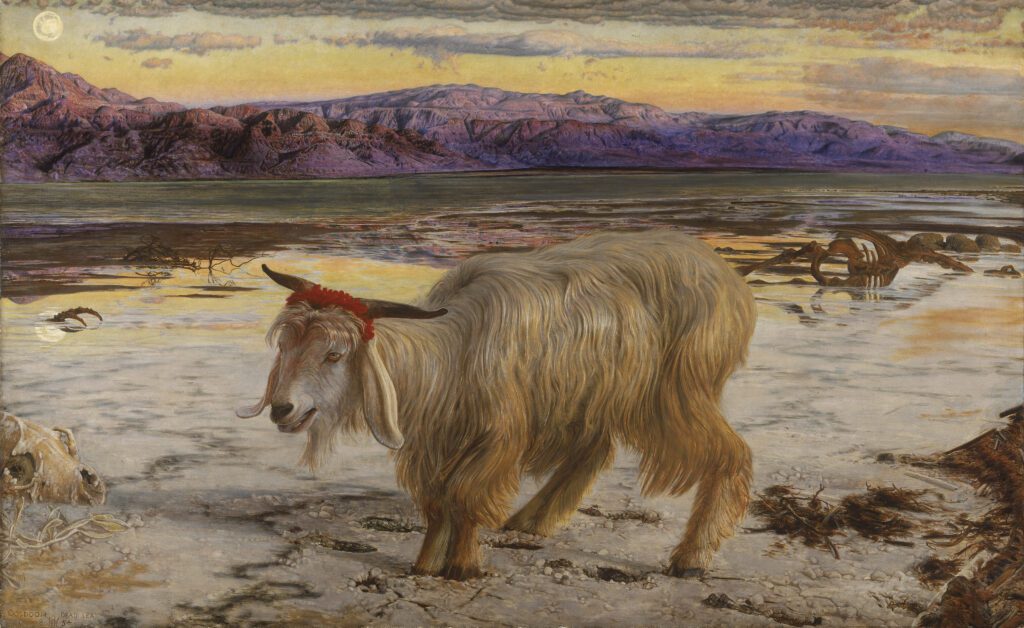
By William Holman Hunt – Козёл отпущения, Public Domain
By Jennifer Garcia Bashaw
Scapegoating claims and accusations have ricocheted throughout the public square in recent months, diluting the meaning and power of the term. On one side, political figures decry the media’s scapegoating of them and dominant religious groups complain about being society’s scapegoats. On the other side, activists and investigative journalists argue that our country’s policies and practices make immigrants, migrant workers and asylum-seekers into scapegoats. So, who are the real scapegoats? And how do we recognize and work against the most dire practices of scapegoating in our country today?
The work René Girard, a French scholar who developed scapegoat theory over his years studying religion and literature, can help us differentiate between the scapegoats and the scapegoaters.[1] In his research, Girard found that scapegoating is a practice in which almost all societies since ancient times have participated. It is a hidden, even unconscious ritual that focuses the violence of a society onto a singular victim, either an individual or a group. When a community accuses that victim, turns against them and eventually kills or expels them, it brings peace. More often than not, scapegoats are innocent of the crimes of which they are accused, but the community does not realize it. They believe the guilt of the scapegoat because to accept the victim’s innocence would make them face the evil and violence in their own hearts, at the heart even of human society.
The Characteristics of Scapegoats
According to Girard, one of the most foundational truths about scapegoating is that the people with power—those in the center of society—are the ones who initiate and perpetuate scapegoating. The scapegoats that insiders choose tend to be similar enough to the members of a society that they can bear its pollution but dissimilar enough to be singled out for blame. The scapegoat must be seen as removed from society by some characteristic or circumstance. Scapegoats, then, tend to be chosen from those who are outsiders, marginalized or have physical differences that cause them to stand apart from the majority. They also tend to be people without family or allies, in order to preclude retaliation from someone on their behalf. These scapegoats are accused of crimes that a society abhors, often taboos, but are themselves usually innocent of these crimes.
Girard’s description of those who have served as innocent victims throughout human history strikes a chord of familiarity for us today as we see our own government focus its inflammatory rhetoric and unjust policies on immigrants, those labeled as the ultimate “outsiders.” Instead of admitting the sins of greed, materialism and selfishness at the heart of our culture and politics, the current powers are deflecting blame onto migrants and refugees, accusing them of stealing jobs, tanking the economy, and committing shocking crimes. Tragically, the scapegoating has moved beyond rhetoric and dehumanizing blame and has resulted in the detaining, physical suffering, and death of immigrants in our country. The United States is sacrificing their scapegoats and some will not survive the ritual.
The Christian Scriptures and Scapegoating
Ironically, the scapegoating violence in American society today comes largely at the hands of political powers who claim to be Christians. This is ironic because Girard’s work shows us that the solution to scapegoating can be found in biblical literature. As Girard was studying ancient myths to uncover premodern processes of scapegoating, he read the Hebrew Bible and the New Testament. What he found in the scriptures of the Jewish and Christian religions became the revelatory cipher to his theory.
In the Bible, as in other cultures’ myths, humans project their own violence onto the divine and fail to grasp that it originated with them. However, Girard sees the Bible as a text in transition between myth and gospel, one that reveals the system of scapegoating through many of its stories and teachings. Whereas myths usually hide the scapegoat mechanism by telling stories from the perspective of the persecutors, the biblical stories regularly speak from the perspective of the victim. In the stories of the Hebrew Bible, we hear Abel’s innocent blood cry out from the ground, we see Joseph prevail and forgive despite the unjust blame forced upon him, and we experience Hagar’s abuse and expulsion along with her naming of God. Hebrew prophetic literature also takes the side of the victim when it rebukes Israel for their abuse of the poor and exhorts them toward justice for the oppressed (as exemplified in Amos and Micah). The prophets set forth a vision of God’s forgiveness that is not tied to law or the sacrificial system but is part of God’s love for God’s people.
According to Girard, this storytelling from the underside crescendos in the New Testament when the Gospel writers narrate the story of a messiah who identifies with society’s victims and calls out the power structures that perpetuate violence. Jesus dies at the hands of those powers and the Gospels reveal him not as a victim of God, but as an innocent victim of a violent humanity. The Gospels’ presentation of Jesus’s life and death portrays elements of the scapegoating mechanism that religious mythology usually masked. When they reveal Jesus as an innocent scapegoat in a long line of innocent scapegoats, the single victim mechanism loses its efficacy. A knowingly innocent scapegoat takes the focus off the victim and onto the systems that perpetuate the scapegoating. Jesus’s story unveils the violence and scapegoating at the hearts of societies and that, according to Girard, is what makes him the scapegoat to end all scapegoats.
Needless to say, Jesus was not the last scapegoat in history. Although the Gospel writers gave Christians the truth about Jesus and scapegoating, the message did not stay at the heart of Christianity for long. As the leaders of the Church became the powers in society, they became the scapegoaters themselves. While there have always been strands of Christianity who stood up for the outsiders and the oppressed, the dominant expressions of the Church throughout history have discounted the anti-scapegoating playbook in the pages of their Scripture. One reason Christians have tended to overlook this antidote is because we do not center the message of the Gospels in our practices and even more foundationally, we do not read the Gospels well. If we did, we would recognize that the whole of Jesus’ story is a guide to welcoming the outsiders, not scapegoating them. From the very first pages of the canonical Gospels, there are literary breadcrumbs that lead us to the overarching mandate to welcome and value the outsider rather than following the powers that dehumanize outsiders and make them scapegoats.
Matthew’s Infancy Narrative: Where Outsider Becomes Insider
A careful interpretation of Matthew’s first chapters demonstrates that the birth narrative of Jesus sets the stage for the anti-scapegoating message of Jesus’s life and death. The Gospel opens with a purposefully structured outline of Jesus’ family tree. Although contemporary readers often skip over the genealogy, thinking the “so-and-so-begat-so-and-so” to be mundane and repetitive, the opposite is true. If one knows what to look for, there are multiple layers of meaning waiting to be discovered in the genealogical lists.
The first layer involves the arrangement of the stanzas. Matthew is not exhaustive in his genealogy; he strategically selects which ancestors he mentions. One clue as to why he limits the list can be found at the end of the genealogy in 1:17: “So all the generations from Abraham to David are fourteen generations; and from David to the deportation to Babylon, fourteen generations; and from the deportation to Babylon to the Messiah, fourteen generations.” When biblical authors use repetition, readers should be alert. Matthew arranges the descendants into sets of fourteen because it establishes Jesus’s connection to King David—fourteen is the value of David’s name in Hebrew numerology. Dalet, or D, is the fourth letter in the alphabet, vav, or “V” is the sixth and because the letters in Hebrew also serve as numbers, the numerical value of David’s name is 14 (D, V, D or 4 + 6 + 4). This may sound like Bible Code mumbo jumbo, but it was common for Jews to refer to the numerical value of names and Matthew’s original hearers would have understood his implication. Forging a strong connection between David and Jesus in the genealogy emphatically confirms that Jesus hails from foretold lineage of the Messiah.
David is not the only historical link Matthew attaches to Jesus in his tri-partite division. When Matthew marks off the stanzas, he uses three different points of reference: Abraham, David and the deportation to Babylon. Here, Matthew is bracketing off the Davidic period (a time of stability and prosperity for the Jewish people) with two time periods during which Israel dwelled in a land that was not their own. During the time of Abraham, an obedient migrant sent by God sojourned in a foreign land. In the Babylonian deportation, a disobedient people exiled by God also sojourned in a foreign land. Matthew’s bookended division here is a reminder that Jesus may have come as the Davidic messiah and king, but his kingdom would be one more suitable for the exiled and the immigrant than the privileged and prosperous.
In addition to structuring the genealogy with purpose, Matthew strategically includes people among Jesus’ ancestors who would raise a few eyebrows. It is certainly unusual that Matthew includes women in his genealogy. Such lists in the Hebrew Scriptures usually traced generations through the males, father to son. But that is not the only irregularity. With the exception of Mary, all the women in Matthew’s genealogy are non-Israelites, people considered foreigners and outsiders in their contexts. Tamar was a Canaanite woman who married two of Judah’s sons and, after being widowed by both of those wicked men, had to use her cunning to fight for the family rights denied to her by Judah (see Genesis 38). Rahab was the prostitute from Jericho who hid the Israelite spies, made a deal with them to save her and her family, and eventually became a part of the fledgling people of Israel (see Joshua chaps. 2 and 6 for this outsider to insider story). Ruth was a woman from Moab—Israel’s sworn enemy, who won the heart of Boaz for being bold, loyal and hard-working (see Ruth). The wife of Uriah, otherwise known as Bathsheba, was part of a Hittite community in Jerusalem and, with a name that means “daughter of Sheba,” she was likely an immigrant from Arabia (see 2 Samuel 11).
It is no accident that Matthew breaks with convention to include four foreign women in his finely hewn introduction. He was adding further scaffolding to the idea that Jesus did not come only from Jewish stock, but from a heritage that blended Gentile and Jewish, male and female legacies. The outsider women Matthew spotlights in his genealogy foreshadow what the rest of the Gospel would confirm: Jesus had come to save not just Israel, but all nations, and anyone who wanted to enter his kingdom would need to embrace diversity in the same way Jesus did.
As we move from Matthew’s genealogy into the birth narrative proper, references to foreign inclusion only multiply. In Matthew 2, we read of the wise men who traveled from afar. No other Gospel mentions these foreign visitors, but Matthew gives them a vital role to play in his infancy narrative. They alone seem aware of the momentous event taking place in Judea, and they are the first ones in Matthew to worship Jesus, the baby born king of the Jews.
For the first readers of Matthew’s Gospel, the appearance of astrologists from the East must have been jarring. What does it mean that three foreign pilgrims anticipated the Messiah being born in Judea, that they paid homage to him while he was still a toddler? For Matthew, it meant everything. When he is writing his Gospel, sometime between 70 and 90 CE, nascent Christianity was already on its way to becoming a multi-cultural, multi-national world movement. His inclusion of these early followers of Jesus demonstrated that from the very prelude of the Jesus movement, God had welcomed the wisdom and contributions of people from around the globe. Matthew’s recognition of these contributions must have spoken volumes to early Christians who struggled with the practical challenges of their diverse body of believers.
Intertwined with the epic journey of the Magi is tale of another cross-country trek: the holy family’s exodus to Egypt. In Matthew 2, the Magi met with the current king of the Jews, Herod the Great, to inquire about a baby who had been born the future king of the Jews. Little did they know, Herod was a jealous, murderous ruler who would not hesitate to eliminate any threat to his throne (he had even killed some of his own children to protect his crown). The Magi followed their instructions—and the star—to worship the child but were warned in a dream to not return to Herod. Meanwhile, Joseph also received a warning in a dream:
Now after they had left, an angel of the Lord appeared to Joseph in a dream and said, “Get up, take the child and his mother, and flee to Egypt, and remain there until I tell you; for Herod is about to search for the child, to destroy him.” Then Joseph got up, took the child and his mother by night, and went to Egypt, and remained there until the death of Herod. This was to fulfill what had been spoken by the Lord through the prophet, “Out of Egypt I have called my son. (Matt 2:13-15, NRSVue)
Throughout Scripture, we see God speaking to people through various means—sometimes in visions or through voices, sometimes through angels or through burning bushes. Here, an angel appears to Joseph in a dream and tells him to leave Bethlehem and journey to another land—all to keep Jesus and his family safe. It is a horrifying situation—a powerful government leader threatening the life of a child and his family. Yet when we tell the Christmas story every year, we somehow gloss over the terror of this part of the narrative. We don’t speak about how frightened and uncertain Mary and Joseph must have felt, or how difficult it would have been for them to uproot themselves from the only country they had ever known and venture to a far-off place where they knew no one. But Matthew wants us to empathize with the family and their situation, to contemplate what it would be like to make such a disturbing decision. Is it better to leave and risk everything or stay and gamble with the safety of their toddler? No parent should ever have to make that decision, not in first-century Judea and not in 21st century America.
But, as Matthew tells us, the young family did have to make the decision, and they chose to flee Israel as refugees. Matthew ends this part of the passage with one of his fulfillment quotations: “This was to fulfill what had been spoken by the Lord through the prophet, ‘Out of Egypt I have called my son.’” Here, Matthew explicitly connects God’s work in the exodus to what is happening in the lives of Mary and Joseph. Just as God rescued God’s people from the tyranny of Pharaoh then, God is rescuing Jesus and his family from the tyranny of Herod. But Matthew does not end his allusions there; he fills out the details of the story with yet another biblical reference:
When Herod saw that he had been tricked by the wise men, he was infuriated, and he sent and killed all the children in and around Bethlehem who were two years old or under, according to the time that he had learned from the wise men. Then was fulfilled what had been spoken through the prophet Jeremiah:
“A voice was heard in Ramah,
wailing and loud lamentation,
Rachel weeping for her children;
she refused to be consoled, because they are no more.” (Matt 2:16-18, NRSV)
Matthew could have focused the story a bit longer on the miracle of Jesus’s birth. He could have told us about how Jesus grew up as a child in Nazareth. But instead, he writes about a paranoid despot who unleashed a slaughter on innocent children. He pauses the story of Jesus’ childhood to tell us about children who never got to grow up. Because of this break in the story, we must pay extra attention to Matthew’s reasons for including this narrative. His initial description is short and to the point, “he sent and killed all the children in and around Bethlehem who were two years old or under,” but in verse 18, Matthew takes a longer moment to reflect on the significance of these slaughtered toddlers. There, Matthew quotes once again from a Hebrew prophet: “A voice was heard in Ramah, wailing and loud lamentation, Rachel weeping for her children; she refused to be consoled, because they are no more.”
Even those who don’t know the reference to Rachel and Ramah should be moved by this chord of grief—it speaks about losing a child and it describes the kind of raw mourning and heartbrokenness that defies comfort. But for the Christians who would have read Matthew’s Gospel in the early Church, these words would have been even more heart-rending and layered with meaning. They would know what Ramah represented. They would have remembered that near that place was where their mother in the faith, Rachel, died in childbirth. They would also know that Matthew was quoting from the prophet Jeremiah in this verse. When Jeremiah first utters these words referring to Rachel’s children, it is in the final years of Judah’s monarchy, in the 6th century BCE. For Jeremiah, the phrase “Rachel weeping for her children” does not refer to her literal children Joseph and Benjamin, but her descendants, the Hebrew people who remained in the southern kingdom of Judah. In Jeremiah’s time, Rachel is mourning for the people of Jerusalem as they are led away into Babylonian exile, marching away from Ramah, the same place where Rachel died generations before.
This reference further strengthens the case Matthew is making for the sojourning nature of the people of God. He is telling a story within a story. The first story is one about a would-be king born in Bethlehem who flees from the tyrannical power trying to destroy him. The second story is much larger, and it circles through time. It is the story of Israel and YHWH, but it is also the story of humanity and God. It is a story about an enslaved, wandering people whom God rescued from a tyrannical power. Why does Matthew include the horrifying tale of Herod and the fleeing family in his infancy narrative? Because it illustrates the kind of world that Jesus was entering alongside the kind of world he came to create. It shows us that Jesus sojourned among us so he could flip the script on our earthly kingdoms. Our world may be a place where corrupt rulers have the power to cause great suffering, where families must flee their homeland to survive, where innocent children suffer and die on a daily basis. But Jesus came to initiate an upside-down kingdom, where outsiders are insiders, and where the refugees and sojourners are the heroes of the story.
It is the continuation of Israel’s story, but it is a new story as well. Matthew wants his audience to know that Jesus had come to lead Israel out of their oppression, like Moses led the people out of Egypt, but he wanted to communicate even more than that. Jesus had also come to counteract the corruption in humanity, the practices and priorities that put people like Herod in charge. Jesus was born not only to save individuals, but to turn the world upside down, to redeem the corrupt and oppressive systems that create refugees and then scapegoat them. He came to teach that God’s kingdom belongs to the outsiders fleeing tyrants, not to the powerful insiders sitting on thrones.
Anti-scapegoating Work Today
It is two thousand years after Jesus fled his country to escape danger, but people still have to flee their countries for fear of danger and destruction. Greed and corruption still plague our societies and children still die at the hands of unjust governments. The weeping of Rachel echoes through history. But maybe that is what Matthew is saying in his infancy narrative. As much as we would like Christ’s work to be completed, we are still living in the age of Herod. We will continue to see oppression and greed, suffering and injustice, and the scapegoating of innocents until the kingdom of God comes fully. But thanks be to God, we have access to the antidote to scapegoating, the biblical message about the life, death and resurrection of Jesus. From beginning to end, Jesus’ story is the story of the refugee, the story of an outsider Israel becoming the insider in God’s reign, the story of an innocent scapegoat who was blamed and killed by the powers of his day. Jesus’ story should be our story as well.
As followers of Jesus, the scapegoat to end all scapegoats, we have the responsibility to carry forward the work of anti-scapegoating. Our government may maintain the power to harm the vulnerable among us, to detain and deport the immigrant, to separate families and destroy the lives of children, but we can work to proclaim the innocence of these scapegoats. The recognition of an innocent scapegoat is the key to unraveling the whole system of violent scapegoating. As more members of our society hear the Rachel voices that have been silenced and recognize the unjust suffering inflicted on our immigrant neighbors, less people will stand for that kind of scapegoating. Less people will vote for it. When we finally wrest control from the scapegoaters in our midst, it will become apparent to all who the real scapegoats have been—the outsiders, the sojourners, the marginalized among us. And then we can do what Jesus intended for his followers to do from the beginning: build God’s kingdom around them.
— Jennifer Garcia Bashaw (PhD, Fuller Seminary) is associate professor of New Testament and Christian Ministry at Campbell University in North Carolina. Dr. Bashaw is an ordained American Baptist minister who enjoys preaching as well training and resourcing pastors. She is the author of Scapegoats: The Gospel through the Eyes of Victims, John for Normal People: A Guide through the Drama and Depth of the Fourth Gospel, and Serving Up Scripture: Interpreting the Bible for Yourself and Others (coming Jan 2026).
[1] See René Girard, The Scapegoat, trans. Yvonne Freccero (Baltimore: Johns Hopkins, 1986).