

Book Review: Conscience, Spirituality, and Religion: Evade Extremisms and Enjoy an Enriched Life with an Axial Age Perspective
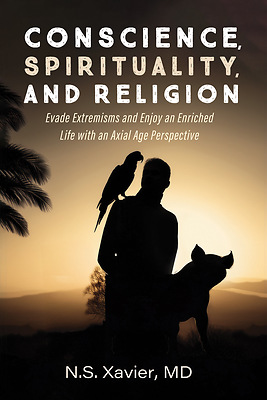
Conscience, Spirituality, and Religion: Evade Extremisms and Enjoy an Enriched Life with an Axial Age Perspective
By N. S. Xavier (Eugene, Oregon: Wipf & Stock, 2025)
Reviewed by Fisher Humphreys
You would think that in the church today we would hear and read a lot more about conscience than we do. At a personal level the culture wars are mostly about issues of conscience such as homosexuality and abortion. At a political level some of the most intense questions are about issues of conscience such as whether it’s right for America to shut out refugees or to bomb Iran, or whether it’s right for President Trump to desert America’s allies, pander to its adversaries, and use the power of his office to get revenge on his personal enemies and to enrich himself and his family. Given that our world is awash with issues of conscience, why are there not more articles and sermons about conscience?
We might assume that the answer is that secularization has eroded our confidence in the reality or importance of conscience. In fact, the opposite seems to be true. Most people seem to think that we all have consciences and that, unless we have intentionally suppressed them, they are trustworthy guides for us as we navigate the moral world that surrounds us. We don’t talk much about conscience for the same reason we don’t talk much about the sun—both of them are obviously there and obviously important.
What N. S. Xavier is doing in his new book about conscience is to build on widely shared assumptions about conscience. He is a retired psychiatrist, the kind who not only wrote prescriptions but spent hours and hours listening to his patients in order to help them cope with their personal problems. What they told him about themselves left him with no doubt that they have consciences.
But if it is already widely agreed that conscience is real and is an important guide in life, what else needs to be said? Dr. Xavier thinks we all need to be more attentive to our consciences and to reflect more carefully about what our consciences are telling us.
He also is challenging his readers to act according to what their consciences are telling them. As a psychiatrist he is fully aware that conscience is not our only inner impulse. We also have what he memorably calls PIG, the problem of instant gratification. It comprises natural human desires that direct us to various behaviors, some of which differ from those to which conscience calls us. We do not need to be ashamed that we have these desires, but neither do we have to act on them. We should let conscience guide us.
Another inner impulse is the superego to which Sigmund Freud alerted us. It is natural to assume that “superego” is a modern, scientific name for what traditionally was known as conscience. In a surprising move, Xavier rejects this assumption. He sees the superego and conscience as separate impulses with incompatible messages. Because the superego is an internalization of external authorities such as our parents and our society, and because those authorities are not infallible, superego may cause us to experience unhealthy guilt and shame. He calls his readers reject the message of the superego and to live by conscience.
Dr. Xavier is convinced that the message of conscience can guide us into a life of happiness. He understands happiness in the way Aristotle did, as a flourishing and fulfilling life. He tells dozens of stories about his patients and others who found their way to a more meaningful life by paying attention to conscience and following its guidance.
Several things are involved in using conscience as a guide. One is moderation; the author calls his readers to avoid extremes. Another is reason and truth; he calls his readers to avoid falsehoods and to be realistic about life. Another is the Golden Rule: treat others as you want others to treat you.
Dr. Xavier is persuaded by his fellow psychiatrist Karl Jaspers’s theory of an axial age in human history. The theory is that over several centuries—approximately 800 BC to 200 BC—human societies in various places in the world, independently of each other, made conscience a centerpiece of their ancient religions and thereby moved from superstition to authentic spirituality. In Israel, for example, prophets such as Amos and Hosea said that God does not accept the worship of people who oppress the poor. Dr. Xavier’s call to his readers to use conscience is a call for them to do on a personal level what the human race did during the axial age.
What I have written so far appears in the first half of the book. The second half comprises nine chapters, one about each of the kinds of fruit of the Spirit listed by St. Paul in Galatians 5:22: love, joy, peace, patience, kindness, goodness, faithfulness, gentleness, and self-control. These virtues are goals towards which conscience directs us.
These nine chapters are beautiful, wise, and practical, and reading them is an inspiring experience as well as a learning experience. For example, for years I have felt that Henry Drummond’s book on 1 Corinthians 13, which is entitled The Greatest Thing in the World, is the richest essay on Christian love I have ever read. Dr. Xavier’s chapter on love is equally rich, and it Includes psychiatric insights that were not available when Drummond wrote his book.
Dr. Xavier’s vision of the importance of conscience and of the relationships among conscience, religion, and spirituality, seems true and important to me. His chapters on the fruit of the Spirit overflow with spiritual and practical wisdom that can enrich the lives of readers. They can also serve as resources for anyone who is preparing to preach or teach about Christian virtues. I am happy to recommend his new book to readers of this journal.




Leave a Reply
You must be logged in to post a comment.
Scan the QR code below to join our exclusive Substack community—subscribe for free or choose to support us with a donation! Just another great way to enjoy and share the journal.