

The Morning Everything Changed
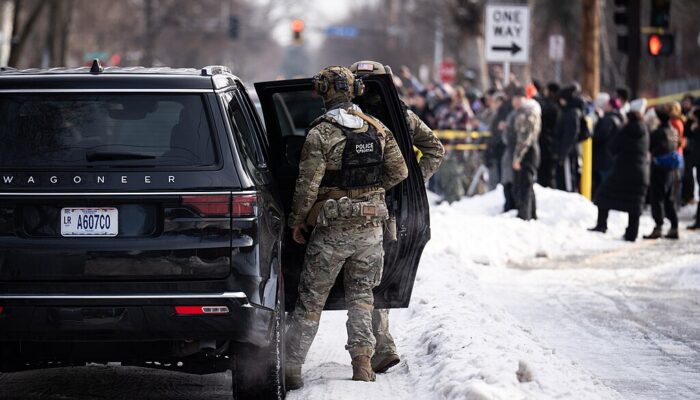
Portland Avenue and 34th Street in South Minneapolis where City of Minneapolis officials have confirmed an ICE agent shot and killed an observer. A neigbhor who saw what happened told local MPR news: “She was trying to turn around, and the ICE agent was in front of her car, and he pulled out a gun and put it right in — like, his midriff was on her bumper — and he reached across the hood of the car and shot her in the face like three, four times,” (Photo: Chad Davis, Wikimedia Commons.
By Hierald E. Osorto
On June 3, 2025, everything changed in our neighborhood.
That Tuesday morning, one of my parishioners burst into my office waving her phone. The photo she had received left me speechless: an army tank parked right outside a local taquería, just blocks from our church. How could it be true? Our vibrant Latine community in Minneapolis suddenly facing the presence of armored tanks and federal agents? I rushed out of the church, my heart racing, desperate to confirm that this was a piece of photoshopped propaganda designed to provoke fear.
At the intersection of Lake Street and Bloomington Avenue an unsettling reality unfolded before my eyes. Three armored vehicles blocked the streets. Federal agents armed with assault rifles and riot gear stood guard beneath an awning promoting the slogan: “Make tacos, not walls.” Neighbors assembled in the road; I joined my voice to the rising protest against this display of government hostility.
Later, I would learn that eight federal warrants related to money laundering and labor trafficking had been executed across Hennepin County that day. In seven of those instances, federal agents—among them Homeland Security Investigations—collected evidence efficiently and inconspicuously. A spectacle of militarized force was reserved for the eight warrants outside of Los Cuatro Milpas restaurant.
Those tanks stayed on our streets for three hours, and so did the growing number of protesters. Deputies from the Hennepin County Sheriff’s Office arrived to do crowd control, while officers from the Minneapolis Police Department—and eventually the Chief of Police—looked on. In order to disperse protesters, the County’s agents eventually escalated tactics to tear gas and physical force. After a deputy pushed my colleague to the ground, I found myself wondering, If this is happening in 2025, what will the future hold for our community?
St. Paul’s-San Pablo Church
The story of St. Paul’s–San Pablo Lutheran Church (ELCA) is a story about immigrant communities. In the late-1800s, Swedish immigrants founded the church as a spiritual home and a hub for connection among new arrivals to the United States. Rooted in the Phillips neighborhood, where over half of the population speaks languages other than English, the congregation embraced a calling to bilingual ministry with Spanish-speaking neighbors (mostly immigrants from Mexico) in the early 2000s. For over 135 years, St. Paul’s–San Pablo has accompanied individuals willing to traverse borders and surmount obstacles in pursuit of a better life in this country.
When the congregation called me to serve as their pastor in 2021, I had already spent a lifetime navigating the shifting tides of government policies towards immigrants. I have cousins named “Ronald” and “Reagan” in honor of the president who signed the 1986 bill granting amnesty to nearly three million undocumented immigrants, and I cared for my little brothers when my stepfather was held in detention in the late 1990s. Yet in this decade, the stakes feel higher, the mood more urgent.
After the 2024 presidential election, St. Paul’s–San Pablo decided to invest intentionally in ways to cope with the stresses incurred by living in the U.S. as an under-documented immigrant. We installed a shower and laundry facilities in our building so that we could extend hospitality to newly-arrived neighbors. We strengthened relationships with a local law firm who counseled members on their legal rights and proceedings in their immigration cases. We’ve brainstormed with our leaders how to foster community well-being and resilience.
Now, if you had asked a year ago whether our ministry addressing the increasingly anti-immigrant climate would have involved acupuncture, I would have responded with skepticism. However, over last spring and summer I have witnessed Christ’s healing ministry manifest through monthly offerings of complementary traditional medicine.
Picture this: gentle lighting and soothing melodies create an atmosphere of serenity. Massage tables and zero-gravity chairs are set up in the sanctuary, inviting neighbors to experience tranquility. Skilled practitioners provide free sessions of acupuncture, Reiki, or cupping therapy, compassionate practices that alleviate the profound stress experienced by undocumented immigrants. I have observed the palpable sense of relaxation exhibited by individuals after engaging in these holistic treatments, as though they are releasing burdens they have long carried. (If it’s still hard to picture, I encourage you to look through the photographs that accompany Giovanna Dell’orto’s Associated Press article from May 2, 2025, titled, “Altar Acupuncture: A Minneapolis Church Brings Well-Being Sessions to its Migrant Ministry”.)
Violent Shock Waves and Communal Strength
The militarized violence of June 3 sent shock waves through the city, but that day also affirmed my community’s strength. Amid the turmoil I watched neighbors come together to push back against bullying, many people documenting the scene. I observed a dear colleague of a predominantly white congregation courageously confront the Chief of Police. I felt a power in collective action that pulsed with the heartbeat of God, who cares for us and calls us to stand against injustice.
The appearance of tanks on our streets caught me off guard, but I won’t submit to fear. I don’t know what the future will hold for my community, but I do know that the people of St. Paul’s–San Pablo won’t be cowed. We will continue to adapt our model of accompaniment and address stress more holistically. We will dedicate ourselves to fostering belonging and welcome in our community, so that all of our neighbors can find sanctuary and solidarity within our walls. We will reclaim our inherent power and faithfully embody the compassion of Christ in our interactions with one another.
I invite you to imagine along with St. Paul’s–San Pablo Lutheran Church how the Spirit is dreaming up possibilities beyond the prevailing climate of oppression, silence, and fear. What kind of faith might flourish when Christians in the United States confront lies with truth, both in private relationships and in the public square? What kind of hope might anchor U.S. Christians to withstand ever-increasing anti-immigrant hostility in every level of government? What kind of love might be born in relationships of accompaniment between your congregation or community and immigrants in your neighborhood or across the nation?
Invading tanks are etched into my mind; their likely return haunts me. Nevertheless, I resolutely resist the terror that threatens to override my nervous system. I rest in the embrace of the Divine, whose grace is all-encompassing and for each person, without exception. That grace guides me back into my immigrant-led community, where we are stewarding with love the incredible gifts we hold together. God has called us for this time, and we are summoning the courage to be—in words dedicated to the memory of Monseñor Óscar Romero—prophets of a future not our own. I hope you will risk that future with us.
— Hierald Osorto is currently the lead pastor of St. Paul’s–San Pablo Lutheran Church, a bilingual ELCA congregation located in the heart of South Minneapolis, MN. Before moving to Minneapolis, he worked at Ithaca College as the Executive Director for Student Equity and Belonging, as well as the founding Director of Religious and Spiritual Life. He holds a Master of Divinity from Austin Presbyterian Theological Seminary and a Graduate Certificate in Theology and Decolonization from the Pontifical Catholic University of São Paulo, Brazil.




Leave a Reply
You must be logged in to post a comment.
Scan the QR code below to join our exclusive Substack community—subscribe for free or choose to support us with a donation! Just another great way to enjoy and share the journal.