

Called to Welcome: Immigration, Theology and Our National Soul
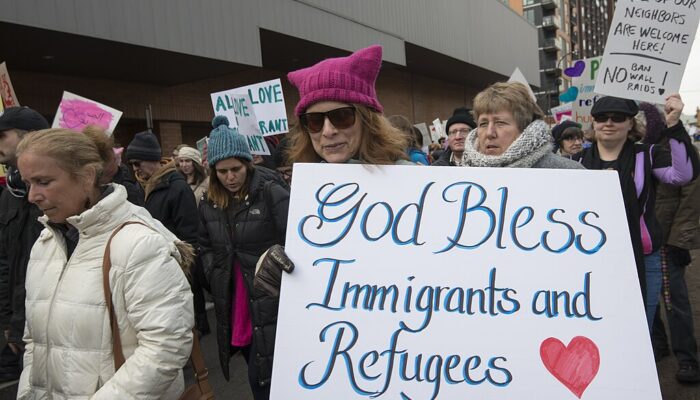
Around 2000 people gathered in downtown Minneapolis to rally in support of immigrants and refugees. Then they marched to the Washington Bridge near the University of Minnesota. The participants called for the end of Donald Trump’s executive order banning people from seven majority Muslim countries from entering the United States. They also spoke against Trump’s proposed wall on the Mexico border. (Photo: Fibonacci Blue. This is licensed under the Creative Commons Attribution License.
By Libby M. Grammer
I recently preached a series on Christian hospitality and, as we explored passages in the Gospel of Luke together to consider what being welcoming as Christ was welcoming looks like today, I recalled with church members the special concern God has for the “least of these.” Now, the “least of these” could be lots of people in our society – many are handed harder lots in life and need the care and support of others. In our scriptures, however, there are special classes of people who are considered marginal to the wider society whom God has called us to tend specifically: widows, orphans and strangers – the poorest and most often neglected. This trifecta of special care finds roots in many of our Hebrew scriptures and in the New Testament.
As church leaders find ourselves mired in a national debate about the topic of immigration, we are confronted with our scriptural mandate to take special care of the stranger – the immigrant – among us—while simultaneously living in a far different society from our Hebrew scriptures. What’s a pastor or church leader to do?
As a Christian ethicist, I have spent many years pondering how we ought to think about topics – not simply what we ought to think about them. When it comes to immigration, there are two main methods of framing the topic:[1]
- Primarily an issue of the rule of law
- Primarily a human issue
If immigration is primarily a legal issue, we are asking questions like, “What is the law?” and “Are people following it?” We hear people who see it this way say things like: “People just need to come the right way and follow the law. Just do it the right way!”
If current laws are not followed – or at least not to the extent we’d like them to be – then the people involved become “criminals” without any reference to other driving forces behind their not following the law. The focus for immigration becomes enforcement of laws with little analyzing of the driving forces behind why immigrants might not be following current laws or the impact of the laws on human lives.
If, however, we frame this issue as a primarily human issue, then we begin with questions like, “Who are the people involved, and how do immigration laws affect them?”
If our focus is on the actual people involved, then we are more likely to care about whether the laws we have affect them in negative ways and then seek to make changes. If our current laws are not tending to the needs of the people involved, then the laws must be analyzed and changed. Laws are meant to be passed to benefit those affected by the harsh realities faced by immigrants who flee their own countries.
Current Immigration Law
As we have seen, it is extremely difficult to pass new laws with diametrically opposed viewpoints among our elected leaders: one focused primarily on enforcement of current law, and one asking questions of the efficacy of current laws and how they affect the wellbeing of immigrants themselves.
As followers of Jesus, I believe we are called to consider all political issues dealing with people’s lives as human issues first; and that means we need to be listening to those affected, listening to the stories of our faith, and finding ways to advocate for just laws based on that foundation.
I have long held that as we explore issues of moral importance concerning real people, it is paramount that we deal in storytelling (more on that later). We know, though, that stories are not the same as factual data. We still need facts and figures to give us insight and information about the situation.
We need to understand just how complicated U.S. immigration is – far more so than most of the talking heads on TV will ever understand. Our current legal system related to immigration is based on a law called the Immigration and Naturalization Act (INA), passed in 1965. Since then, a few follow-up laws have dealt with specific situations in immigration law, but none have fully reformed the original INA. Another law passed in 1986 called the Immigration Reform and Control Act (IRCA) provided amnesty to certain undocumented persons already in the U.S. but did not provide any pathway for new immigrants. This bill also had provisions to punish unscrupulous employers hiring undocumented immigrants, hoping to curb the demand for cheap foreign labor.
The last immigration law (still not comprehensive reform) passed by Congress was in 1996 and included many enforcement provisions. But it also ended up creating some rules that now bar someone’s reentry for years (or forever) if immigrants have entered unlawfully (without inspection) and stay for certain periods of time. I won’t get into the depths of this, but in some ways, our law created the large swaths of people without status by closing off pathways for them to come out of the shadows and get status lawfully, rejoining family or working in industries that rely on them.
Approximately 11 million undocumented immigrants live in our country, some of whom entered unlawfully and some of whom entered legally and overstayed their visa time period. Undocumented immigrants represent 23% of the foreign-born population in the United States. Most immigrants have legal status.[2]
Interestingly, 46% of undocumented immigrants had minor children as of 2010. By comparison, 38% of legal immigrants (including naturalized citizens) and 29% of U.S. native-born citizens had minor children. That’s roughly 5.25 million children of undocumented immigrants in the U.S., roughly 850,000 also undocumented and 4.4 million native-born U.S. citizens.[3]
Undocumented immigrants are overwhelmingly Latino/a, with over 7.8 million of the 11 million undocumented coming from Latin America.[4] Of these, four million are of Mexican heritage.
The 2007 median income for undocumented immigrants was $36,000 per year, which is well below the mean of $50,000 per year for U.S.-born persons. According to the Pew Center’s research, “a third of the children of unauthorized immigrants and a fifth of adult unauthorized immigrants lives in poverty. Undocumented immigrants are largely unqualified for government support, and only U.S. citizen children can legally obtain these benefits.[5]
With much bravado, the current administration embraces immigration as primarily one of the rule of law. The response from the administration is to seek to militarize the border, fund large detention centers, and focus their energies on enforcement without much effort toward legal solutions. Their aim to deport as many people as possible uses fear as intimidation to control migrant populations.
Even those seeking to regularize their immigration status live in fear of being caught by Immigration & Customs Enforcement (ICE) as they attend mandatory check-ins or immigration interviews or immigration court proceedings. As you may have seen in the news, there’s limited due process afforded to immigrants, even immigrants who have status, like foreign students studying at universities who, in disagreeing with the administration’s policies, have found themselves suddenly without status.
Even as people sought legal status by embracing new policies—like temporary protected status (TPS), giving legal status to certain groups of people fleeing violent countries— positioned to bring them out of the shadows, that rug has now been ripped out from under most of them, with only a couple of weeks to leave the country to the places they have fled. They are provided a $1,000 check and told to “self-deport.”
Immigrants have been taken off the streets by plainclothes and masked ICE agents and then denied access to an attorney for many weeks, and making it difficult for their families to find in the vast dentition systems.
All the while, the United States Citizenship and Immigration Services is vastly underfunded and has backlogs so long that people who have filed petitions have to wait months, even years, for approval, meaning they could have had status a lot sooner had things been working properly. And of course, without bipartisan support, there’s not going to be meaningful immigration reform through Congress.
What do we have available to us from Congress these days? The “One Big Beautiful Bill,” this budget reconciliation bill, while not specifically an immigration reform bill, has within it some of the administration’s focus on immigration enforcement. As you know, the president has tried (and, so far, failed) to undo the 14th amendment to birthright citizenship to children of immigrants.
In the meantime, then, those citizen children of undocumented immigrants have been targeted in the bill to ensure the parents do not receive the child tax credit for their citizen children.[6] (NOTE: These are taxpaying immigrants who use an ITIN, individual taxpayer identification number, to pay their taxes instead of a Social Security Number.) Taking away a credit for their citizen children is meant to hurt their families financially.
Seventy-five billion dollars has been earmarked for enforcement, including $45 billion for immigration jails for people without status – a noncriminal offense, mind you. If someone has no other offense than lack of status, they are not “criminals,” but simply have a civil immigration offense. The bill also provides $1.3 billion to hire immigration judges and expand courtroom capacity to address backlogs and speed up the process to remove immigrants from the country.
Additionally, asylum-seekers will be charged $100 just to apply, most of them fleeing war-torn countries and who have nothing but the shirts on their backs and who have lost any money they did have to smugglers who helped them go across many borders to get somewhere safe. Then, while waiting for their asylum request to work through courts, they will have to pay $550 to apply for work authorization, and $275 for renewal of that authorization every six months to continue to work legally.[7] Remember, in a lot of states, they’ll be making the federal minimum wage of $7.25/hour. It would take two five-day workweeks to even make enough money to pay the fee, and then they have to live on $580 (less taxes) for the month.
We could keep going with the ways in which this administration chooses to target foreigners within the U.S. who have no legal pathways to immigrate to the U.S. But the reality is that what we’re hearing in the news isn’t the whole story and, as Christians, dealing with immigrants must have more reflection than simply jumping on a bandwagon of anti-immigrant rhetoric and laws. [8]
Christian Ethical Reflection on Immigration
How do we deal with the fact that 11 million of our neighbors have no immigration status and live among us mostly in poverty? How do we love them? What does justice look like?
No matter how many figures we have, the information most needed is the “why.” We need to know: Why are these people fleeing their countries of origin, where presumably they have family and deep roots? Why are they unable to obtain immigration status? Why did our laws get passed as they were?
Stories are the “face” of facts. We learn the human background of information to create space for the voices of those affected to be heard. There are many brave immigrants who have told their stories openly, sharing how these fearful moments of ICE arrests have upended their lives, even as many of them are in the process of regularizing their immigration status. Though Americans are being told these are all criminals, the reality is that less than half of detainees have any criminal record. Since June 14, 2025, 65% of people taken by ICE have no criminal convictions at all, and 93% had no violent convictions.[9] Stories of human beings attempting to find freedom in our country, many following our laws and trying to obtain immigration status, must be the focus of our interest in this subject.
And we are faithful to our religion in telling stories and, as church leaders, our call is to impart the scriptures to help us understand our faith, our God and our call to love others. Our scriptures are full of stories that teach us something about our moral lives. And specifically related to immigration, we have stories about immigrants to give us guidance.
In the Old Testament, we have many stories of humans who became migrants. From the very beginning in Genesis, we learn that people are all made in the image of God (Gen. 1:1) and thus have worth, regardless of their lot in life. We remember the stories of Abraham, Isaac and Jacob who both were migrants and hospitable (Gen. 11:31-12:9; Gen. 35:27; Gen. 28:4; Gen. 32:4). We also remember the story of Israel as sojourners in Egypt, living there after a famine drove them out of their homeland (Exod. 1).
We remember stories of immigrants coming into Israel—such as the Moabite Ruth, who accompanied Naomi after her Israelite husband died (Ruth 1-2; Note: Moabites were not universally liked – Num. 22-25; Deut. 23:3). And in Hebrew, we recognize various words for “foreigner” like the nouns gēr and tôšab and the adjectives nokrî and zār. The word gēr is the most used word for foreigner because, unlike the other terms, it means someone who has come to a place to stay (so think “immigrant” verses temporary visitor).
God gave instructions to the Israelites to care for the alien or immigrant among them because they were once aliens in Egypt (Lev. 19:33-34). God gave special instructions to care for the immigrant by allowing them to glean from the edges of the harvested fields (Lev. 19:9-10; Deut. 24:19-21), and asked Israel to provide funds to care for them (Deut. 14:28-29; 26:12).
Immigrants were in the same category with orphans and widows in the Old Testament –for whom special care was insisted (e.g., Deut. 10:18, 14:28-29, 16:11-14, 24:19-21, 26:12; Ps 146:9; Jer. 22:3; Zech. 7:10; Mal. 3:5).[10] And when Israel failed, prophets would be raised up to call them out for their lack of care for immigrants and other protected classes of people (Jer 23:3; Ezek 22:7, 29; Mal 3:5; c.f. Ps 94:6).[11]
Now, that doesn’t mean the Old Testament doesn’t have some tensions about foreigners. Every time Israel was surrounded by people following other gods, they were called to live differently. That often that meant doing away with foreigners in various ways (Deut. 7, 23; Ezra 9-10; Neh. 13). Remember, though, that it’s only when Israel is in danger of assimilating into foreign practices while in exile that these issues arise. And, in fact, these passages are not dealing with immigrants (the gerim, or resident aliens) living in Israel at all.
If we are to look at the whole of the Old Testament, we see that when it comes to immigrants in their midst, God’s laws were on the side of the immigrant more often than not. The command to love the alien in their midst is the second most repeated commandment other than to worship only one God.
This care for the last and the least permeates the messages from the prophets and Jesus’ ministry in the New Testament as well. In the New Testament, there’s less focus on the stranger directly since Jewish people were under Roman rule at the time; however, the witness of Jesus’ ministry and teaching points toward an inclusivity of all nations we can’t ignore. First, Jesus’ own family fled persecution as Herod slaughtered Hebrew children (Matt. 2:13-23). Theologically, Jesus is seen as a “divine immigrant,” leaving the glory of heaven to sojourn among us in humanity (Phil. 2:6-8).
Jesus called people to minister to the outsiders, such as the Samaritans, a hated group that believed differently and from whom the Jewish people were estranged. They weren’t just outsiders, but enemies. And still, Jesus chose to engage these “foreigners” and outsiders and enemies as bearers of God’s Kingdom in the story of the Good Samaritan (Luke 10:25-37) and the Samaritan woman at the well who ran to tell the story to her village (John 4:4-42).
Jesus was also painted as a gracious host, including people of all backgrounds and situations – sharing meals with those the religious elite would ignore in order to share the message of God more widely (e.g., Matt 9:9-11, 15:31-33, 21:30-32; 26:25-27; Mark 2:14-16; Luke 14, 19:1-10; John 6:4-6).[12]
The Early Church followed suit, offering gracious hospitality to all. The Greek philoxenia, (phileo, affection + xenia, stranger), translated “hospitality” in English, was meant for strangers.[13] They ate and shared things in common (Acts 2:44) and when tensions erupted between the rich and the poor, the insider and the outsider, they were called on in letters to offer equal respect (Acts 10-11; Gal 2:11-14; 1 Cor 11:17-34; Jas 2:1-13).[14] Ethiopian eunuchs were baptized (Acts 8:26-40) and Jews and Greeks, slave and free, were all one in Christ (Gal. 3:28).
There are yet still tensions however about how to follow the law in the New Testament. For those who would interpret immigration through a legal lens, they might focus instead on passages like Romans 13 (“let every person be subject to governing authorities”) or Matthew 22:15-22 (paying taxes to Ceasar), where followers of Jesus were instructed to follow the laws of the land.
These passages cannot be taken from their contexts, however. In Matthew, Jesus calls people to live drastically differently from the world around them even as they pay their taxes, and in just a chapter before in Romans, Paul asks the believers to be shaped by God’s love and not the pattern of this world. Also, let’s be real: Paul’s own teachings got him thrown in jail.
As we listen to these stories and hear God’s message about strangers and foreigners, we do so keeping in mind the immigrants who live among us, who are made in God’s image, whom we are called to love and protect and care for, as emphasized in scripture, and who have a story to tell us about God’s mercy and love. Jesus himself said that when we see someone with no home, the person in prison, the strangers among us – we are seeing Jesus and should act accordingly.
Living Our Immigration Ethic
Applying our faith isn’t a one-size-fits-all. Our stories in scripture aren’t a 1:1 correlation to today’s immigration laws in a democratic country. There may legitimately be differences of opinion as to how best we go about formulating immigration policy that protects and welcomes.
But we can apply what we know from our faith by living democratically together. We review our laws to see where they fall short of the justice we should offer people around us we are called to love. We with the privilege of citizenship (and especially those of us with white complexions) can listen more and speak less when issues of human importance are discussed, putting ourselves in someone else’s shoes, trying to understand, rather than simply protecting our own interest.
Though this article cannot fit all our scriptural stories and the stories of modern-day immigrants, we are still called to know these stories and let them move us to compassion. I encourage pastors and church leaders to take seriously the real stories of immigrants and what they face in our current political climate and to apply their knowledge of our holy scriptures to inform how they advocate for the immigrant among us.
We need to stand in solidarity, to choose to minister locally, even when you minister in difficult circumstances. We might face opposition for our work. We need to support immigration reform, lobbying for bipartisan support where it’s possible, overcoming the harmful rhetoric prevalent in politics today. And we must say something. Don’t let the world rob whole groups of people of their cherished identity in God’s image. As Proverbs 31:8 says, “Speak for those who cannot speak.”
U.S. immigration is inextricably tied to our brothers and sisters in Christ all over the world. Just as we are called to share the love of Jesus locally and globally, so too is our love for immigrants a love for people wherever they are and wherever they come from. After all, the Great Commission is for all nations (Matt. 28:1-20).
— Rev. Dr. Libby M. Grammer is the senior minister of Lakeside Church in Rocky Mount, North Carolina. She is also the author of Privilege, Risk, and Solidarity: Understanding Undocumented Immigration through Feminist Christian Ethics (Wipf & Stock, 2017). Dr. Grammer has served churches in Virginia and North Carolina since 2015 and also served as an immigration legal assistant for 10 years. For more information, visit www.libbygrammer.com.
________________________________
[1] There are many variations to these two emphases, depending on whether someone would be willing to weight one more than the other; however, for purposes of this article, we will discuss which of these is primary.
[2] Jeffrey S. Passel and Jens Manuel Krogstad, Pew Research Center, “What we know about unauthorized immigrants living in the U.S.,” Pew Research Center, July 22,2024, https://www.pewresearch.org/short-reads/2024/07/22/what-we-know-about-unauthorized-immigrants-living-in-the-us/.
[3] Passel and Krogstad, “What we know about unauthorized immigrants living in the U.S.”
[4] Passel and Krogstad, “What we know about unauthorized immigrants living in the U.S.”
[5] Passel and Krogstad, “What we know about unauthorized immigrants living in the U.S.”
[6] National Immigration Forum, “One Big Beautiful Bill Act: Immigration Provisions,” July 7, 2025, https://immigrationforum.org/article/one-big-beautiful-bill-act-immigration-provisions/
[7] National Immigration Forum, “One Big Beautiful Bill Act.”
[8] If you want to know more, the most comprehensive and easy-to-understand policy advocacy group I know is the American Immigration Council: https://www.americanimmigrationcouncil.org/
[9] David J. Bier, “65 Percent of People Taken by ICE Had No Convictions, 93 Percent Not Violent Convictions,” Cato Institute, June 20, 2025, https://www.cato.org/blog/65-people-taken-ice-had-no-convictions-93-no-violent-convictions.
[10] Citations from M. Daniel Carroll R., Christians at the Border: Immigration, the Church, and the Bible (Baker Academic, 2008), 91-112.
[11] Ibid.
[12] Carroll R., 113-134.
[13] Christine D. Pohl, Making Room: Recovering Hospitality as a Christian Tradition (Grand Rapids: Eerdmans, 1999), 31.
[14] Pohl, Making Room, 32.




Leave a Reply
You must be logged in to post a comment.
Scan the QR code below to join our exclusive Substack community—subscribe for free or choose to support us with a donation! Just another great way to enjoy and share the journal.